Optimal water absorption
2,940 nm wavelength hits the absolute peak of water absorption, vaporising damaged cells cleanly without unwanted thermal spread.
Gold-standard German Erbium:YAG laser resurfacing for fine lines, atrophic acne scarring and photo-ageing — delivering transformative clinical renewal with rapid 5–7 day re-epithelialisation.
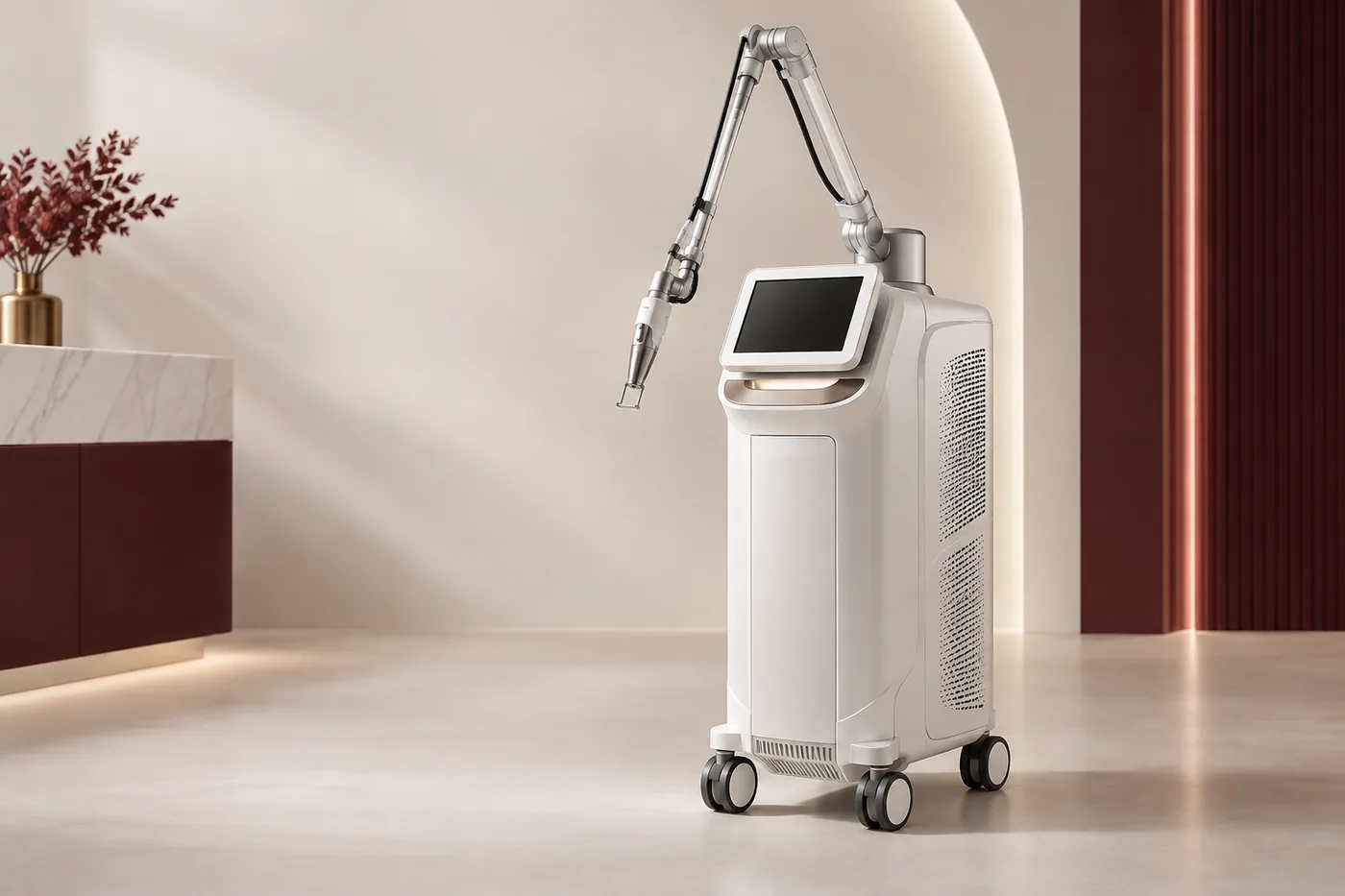
The Asclepion Dermablate is an advanced, German-engineered medical laser operating at a pure 2,940 nanometre Erbium:YAG wavelength. Its defining physical property is an extraordinarily high affinity for water in human tissue — absorbing water approximately 10 to 15 times more intensely than traditional 10,600 nm carbon dioxide (CO2) lasers.
Because human skin is composed largely of water, Er:YAG laser energy is absorbed instantaneously in the most superficial microscopic cell layers. This enables 'cold ablation' — cleanly and uniformly vaporising damaged, photo-aged cells and pitted scar tissue micron-by-micron (typically 10 to 50 microns per pass) with a virtually undetectable thermal rim (under 30 to 50 microns, compared to over 200 microns of collateral heat damage with CO2). By removing damaged tissue without bulk heating the surrounding dermis, the Dermablate triggers a controlled, rapid healing cascade: fresh epidermis migrates from follicular reservoirs within 5 to 7 days, while deep dermal neocollagenesis continues to remodel and tighten the structural collagen framework for 3 to 6 months. This gives patients clinical-grade resurfacing comparable to CO2, but with substantially reduced redness, minimal crusting, significantly faster recovery, and a markedly lower risk of post-inflammatory hyperpigmentation (PIH), making it far safer across Fitzpatrick skin types I through IV.
2,940 nm wavelength hits the absolute peak of water absorption, vaporising damaged cells cleanly without unwanted thermal spread.
Because thermal injury is kept under 50 microns, new skin re-epithelialises within 5 to 7 days, halving the social downtime associated with traditional CO2 resurfacing.
Minimal residual thermal damage significantly reduces the risk of post-inflammatory hyperpigmentation, making treatment safer across diverse skin tones (Fitzpatrick I–IV).
From a 100-microsecond 'cold' micro-peel for radiant texture to deep fractional pulses that break down tough fibrotic acne scar tissue.
Triggers genuine dermal collagen synthesis that tightens, firms and refines skin quality for up to five years.
Every pulse, pass and depth setting is directly evaluated and administered by Dr Farzana Khan in a clinical setting.
Patients often ask us about the following in everyday language:
Dr Farzana examines your skin topography under medical magnification, assesses Fitzpatrick classification, and selects either fractional micro-columns for accelerated healing, full-field ablation for deeper perioral lines, or a combined staged approach.
High-strength prescription numbing cream is applied for 45 to 60 minutes before treatment. Specialised protective ocular shields are placed to ensure total patient comfort and eye safety throughout.
The German-engineered Asclepion Dermablate handpiece glides over targeted zones, vaporising microscopic columns of damaged tissue with sub-micron depth precision, leaving surrounding healthy tissue intact to accelerate recovery.
A soothing occlusive protective balm—frequently paired with ASCE+ Exosomes or PRP where requested—is applied immediately to lock in hydration, calm the tissue, and expedite re-epithelialisation.
Follow-up review ensures seamless epithelial healing. Periodic non-ablative maintenance or biostimulator sessions can be scheduled to preserve collagen integrity long-term.
Suitability is determined through thorough clinical examination by Dr Farzana Khan. Where appropriate, pre-treatment priming and conservative patch testing are conducted to ensure maximum safety.
Understanding the physics of laser wavelengths helps clarify why the 2,940 nm Erbium:YAG is the premier choice for modern skin resurfacing.
Treatments may not be suitable for everyone. Suitability is confirmed during a private medical consultation, including a review of your medical history, medications and goals. Side effects, alternatives and realistic outcomes are discussed openly. Results vary between individuals. This page is general information only, not medical advice.
The Erbium:YAG laser operates at 2,940 nm, corresponding precisely to the peak of water absorption in human tissue—absorbing water 10 to 15 times more efficiently than a 10,600 nm CO2 laser. This allows 'cold ablation', vaporising damaged epidermal layers with micron accuracy while confining residual heat to an ultra-thin rim under 50 microns (compared to 200+ microns with CO2). As a result, healing is twice as fast (5 to 7 days vs 14 to 21 days), prolonged redness is greatly minimised, and the risk of post-inflammatory hyperpigmentation is substantially lower, offering a significantly safer profile across diverse skin types.
During days 1 to 3, the skin feels warm like a sunburn, accompanied by mild swelling and bronzing micro-crusts. Days 4 to 6 involve gentle shedding as old skin exfoliates during washing with cool water. By day 7, fresh, smooth, luminous pink skin emerges. Normal social activities and mineral makeup can comfortably be resumed around day 7. Pinkness continues to fade over subsequent weeks, while new collagen formation continues to remodel and refine skin quality for 3 to 6 months.
Results from ablative Erbium resurfacing can endure for five years or more. While natural biological ageing continues, the newly laid down collagen and elastin provide lasting structural support. Patients often preserve their radiant results indefinitely through diligent daily mineral SPF 50+ sun protection, high-grade topical skincare, and occasional gentle maintenance sessions.
Patient comfort is maintained throughout. A medical-grade topical anaesthetic cream is applied 45 to 60 minutes before treatment to thoroughly numb the area. Most individuals describe the laser sensation as a mild prickling warmth or light elastic snap. Cooling air and soothing post-treatment balms further promote immediate comfort.
A single medium-to-deep session often produces transformative smoothing of skin texture, fine lines, and sun damage. For deeper atrophic acne scarring or pronounced perioral rhytids, a personalised course of 2 to 3 sessions spaced 6 to 8 weeks apart achieves optimal structural revision. Benign superficial lesions such as skin tags or seborrhoeic keratoses are typically removed in a single short appointment.
Erbium:YAG possesses a substantially safer profile for higher Fitzpatrick skin types (III–IV) than traditional CO2 lasers because it causes minimal collateral thermal heat spread. For patients with olive or deeper skin tones, Dr Farzana utilises fractional delivery modes, conservative energy fluences, and structured pre-treatment melanin-regulating preparation to ensure maximum safety and protect against pigmentary shifts.
Yes. The precision of the 2,940 nm wavelength allows delicate tailoring for sensitive anatomic zones including the neck, décolletage, hands, and periorbital eyelid skin. Because extra-facial skin contains fewer sebaceous glands and hair follicles, Dr Farzana selects specialised fractional settings with adjusted fluences to ensure smooth, safe healing.
Non-ablative lasers (such as 1,550 nm Erbium Glass) heat underlying dermal tissue without vaporising the surface stratum corneum. While non-ablative treatments have minimal recovery time, they require multiple sessions (typically 4 to 6) for subtle change. In contrast, the ablative 2,940 nm Asclepion Dermablate physically vaporises damaged outer skin layers, enabling profound textural correction, scar revision, and dramatic wrinkle reduction in one to two treatments.
Combining modalities produces outstanding synergistic results. Pairing Dermablate laser resurfacing with ASCE+ stem cell-derived exosomes or PRP dramatically accelerates re-epithelialisation, calms inflammation, and doubles collagen synthesis. For patients with deeper skin laxity alongside surface texture concerns, combining Morpheus8 RF microneedling (for deep subdermal tightening) with Dermablate (for superficial epidermal resurfacing) offers complete full-thickness restoration.
Dr Farzana provides a personalised preparation protocol during consultation. Patients are advised to pause active topical acids, retinoids, and exfoliating scrubs 5 to 7 days before treatment, avoid UV exposure and tanning, stay well hydrated, and in cases of past cold sores, complete a brief prophylactic antiviral course.
Patients often consider this treatment for the following concerns. Suitability is confirmed only at a private medical consultation.
Patients can request a private consultation depending on clinic availability across:
Book a private consultation with Dr Farzana to discuss your concerns, suitability, treatment options, expected outcomes and aftercare.
BOOK PRIVATE CONSULTATIONShare a few details and we will arrange a discreet, doctor-led consultation. We never share your information.